
Signet rings bearing coats of arms or heraldry
All our jewelry is custom-made in our workshop in Nantes. If you'd like to treat yourself or someone special to a unique piece of jewelry , come visit us at our workshop or call us at +33 (0)2 85 52 38 63
A bit of history
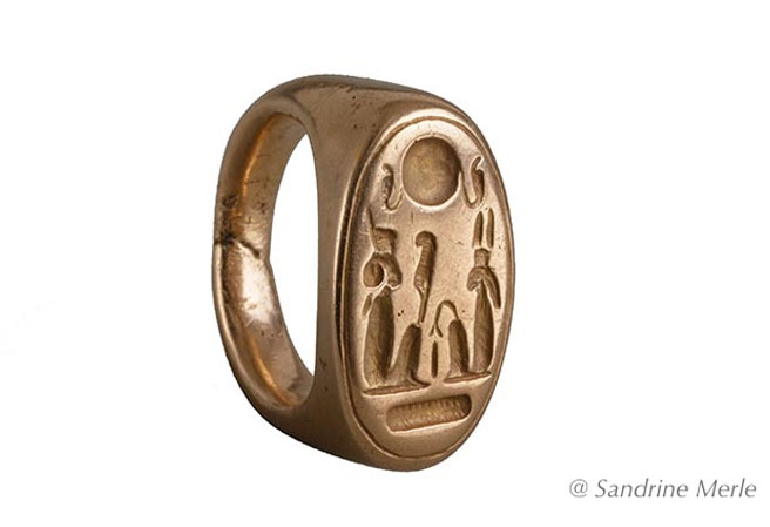
The history of signet rings is over 4,000 years old and dates back to ancient Egypt, when rings were adorned with hieroglyphs, a sign of social rank, power and useful for sealing commercial relationships.
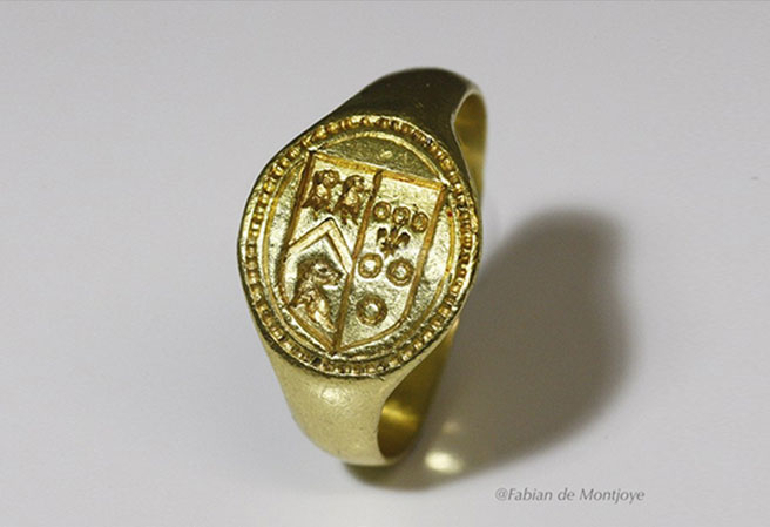
It was during the Middle Ages that the signet ring appeared in France, where it was then exclusively made of yellow gold. Hieroglyphs gave way to seals representing family coats of arms. This specific and highly symbolic piece of jewelry was then worn by all the nobility. They used it to seal their documents with wax, using their heraldic crest, thus authenticating them. In this period of widespread illiteracy, this system made it easy to identify the author of the letters.
Over time, with the democratization of writing skills, this ring, also known as a "seal ring," lost its usefulness. Gradually, wax seals were replaced by handwritten signatures, and the signet ring fell out of fashion. It finally experienced a on in the 18th century, a period during which it became fashionable again, initially among on . Still imbued with social status, it was particularly prized by the elite, who displayed their long lineage in this way. It symbolized heritage and family history and was passed down from generation to generation. At this time, it became a true fashion accessory.
Evolution of the heraldic tradition
From the 19th century onwards, gold was no longer the exclusive domain of heraldic signet rings, and family coats of arms began to appear engraved on precious stones using the intaglio technique. It was also during this period that women began to wear this type of jewelry on their left little finger.
Traditionally, the signet ring is worn on the left ring finger by the eldest son of the family, the head of the family name and arms. Younger sons wear it on the right little finger. Nowadays, however, it is more common to see it worn on the left ring finger by many men.
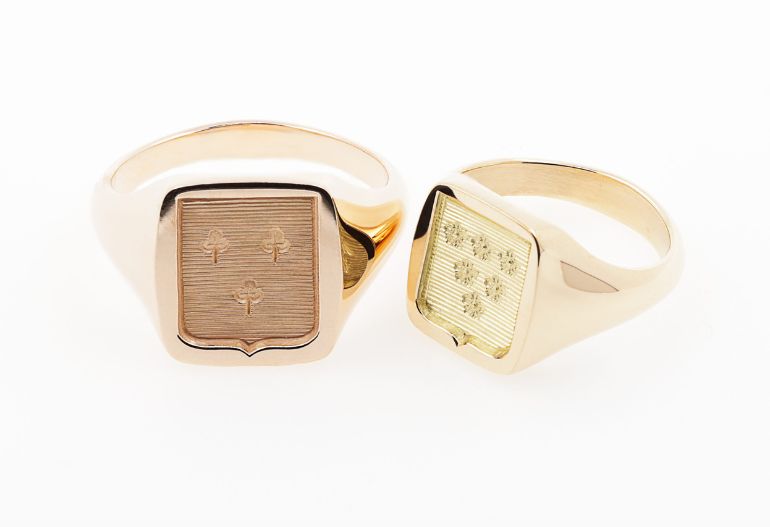
Since the end of the French monarchy, the wearing of signet rings has become widespread and is no longer exclusively reserved for a certain class. Anyone can create their own coat of arms or seek the help of a heraldist to design one, thus respecting the associated codes.
Nowadays, rose gold has also made its appearance in this world and this color is now highly prized.
Symbolism of the coat of arms
In France, women's coats of arms are traditionally diamond-shaped or oval.
As for those of the gentlemen, we mainly find the scutiforme of ancient or modern size.
The coats of arms of noble families can be "crowned", that is to say surmounted by a crown (if the family has a title of nobility), by a helm, that is to say a squire's helmet with or without mantling (symbol of chivalry for those who do not have a title), or finally by a mantle for princes and sovereigns.

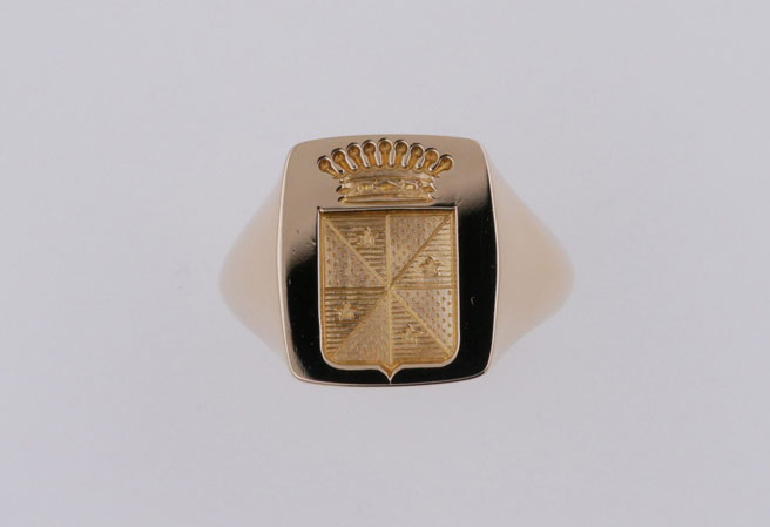
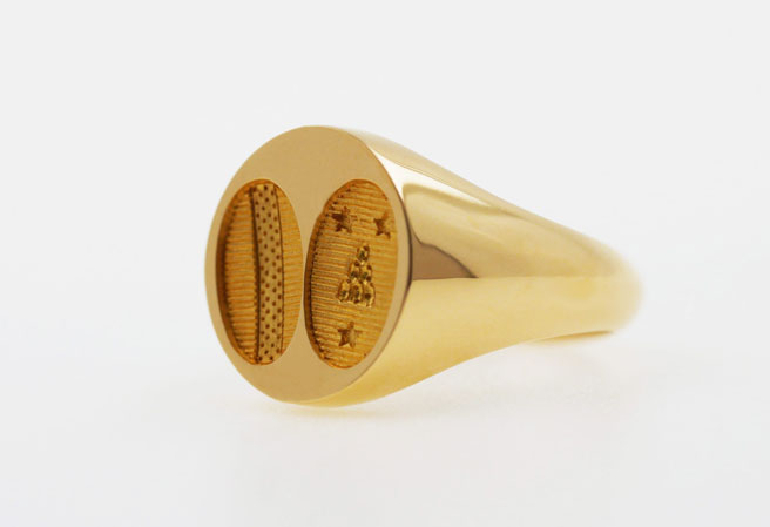
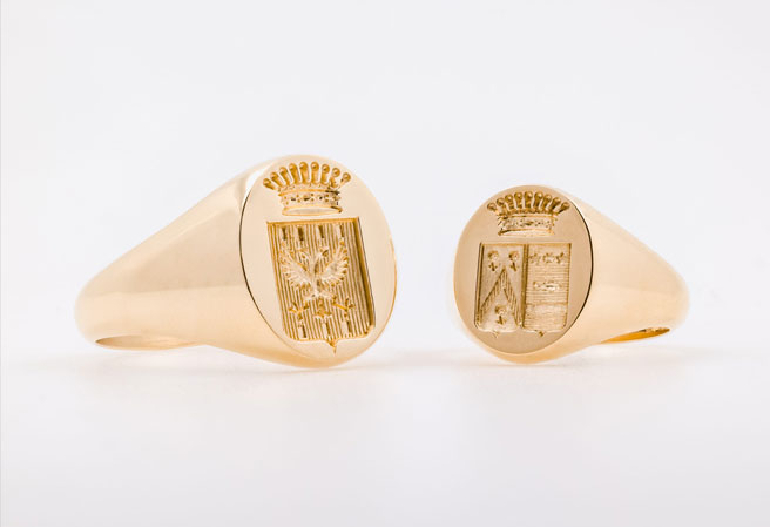
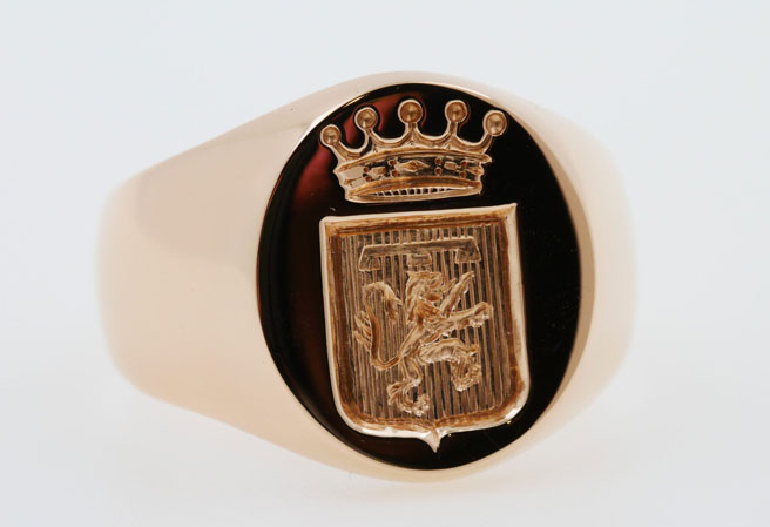

The engraving
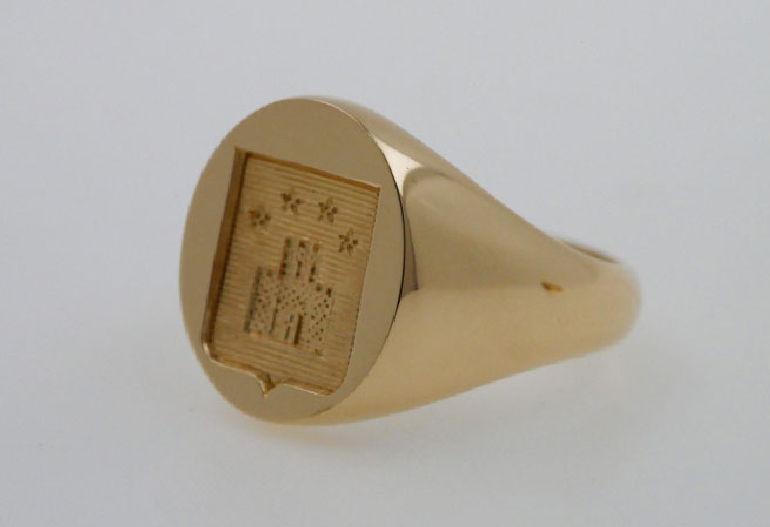
Signet rings bearing coats of arms are engraved in intaglio or negative space to reveal the blazon upright when the wax seal is applied. Intaglio engraving involves cutting into the metal to create shapes and relief.
A disappearing skill
This fabulous and demanding craft, listed in the Inventory of Intangible Cultural Heritage in France, requires great dexterity, on precision, and exceptional attention to detail. These true artists, the sculptors, create their work using numerous tools and tools. The art of engraving is unfortunately dying out, and engravers are becoming increasingly rare in France. As a result, production times have increased and require patience (from 4 to 6 months depending on the time of year).
Nowadays, more and more engravings are done with lasers. As guardians of an ancestral heritage, our workshop has chosen to value heraldic engraving, traditionally handcrafted by a qualified and certified artisan engraver. These hand engravings make each signet ring absolutely unique, and their depth ensures its enduring appeal.
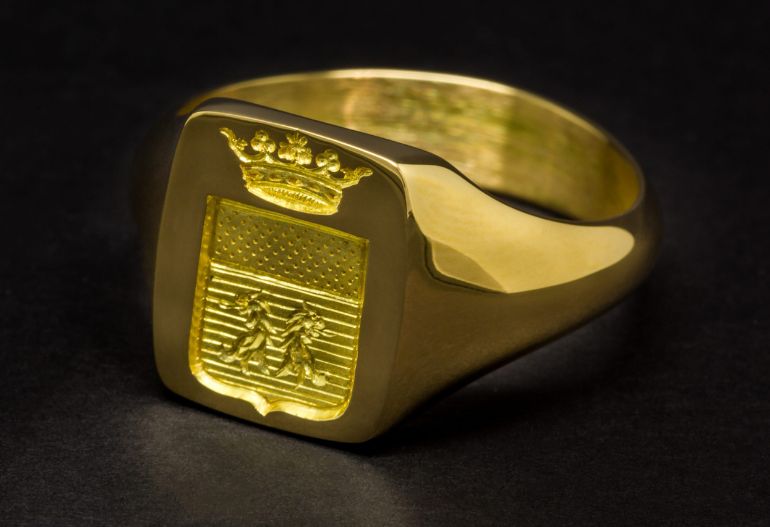
The specialty of Maison Griffon Joailliers
Custom creation also allows for some creative freedom within the highly codified world of the heraldic signet ring. For example, the ring can be made of two-tone metal, inlaid with ebony, or even reimagined as a signet ring, transforming it into a bracelet. A truly vast realm of possibilities…

Rose gold heraldic signet ring, domed face, modern-cut crown and shield, and set with an ebony piece at the shank
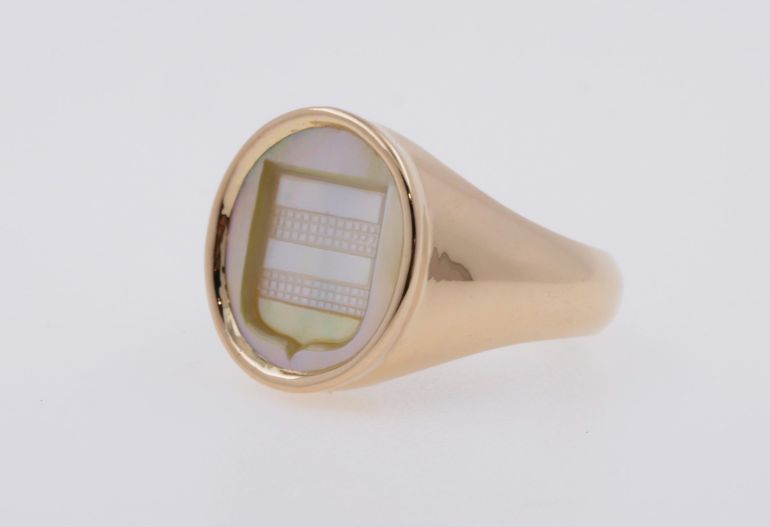
Signet ring with coat of arms and shield, modern size, engraved in mother-of-pearl

Two-tone signet ring with a platinum face and yellow gold body, crown, modern-sized shield and lambrequins
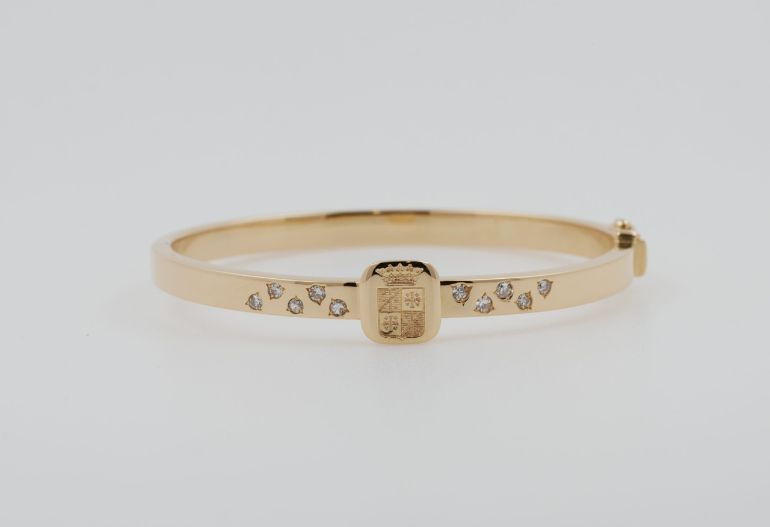
Coat of arms worn on a bangle-style bracelet, adorned with diamonds
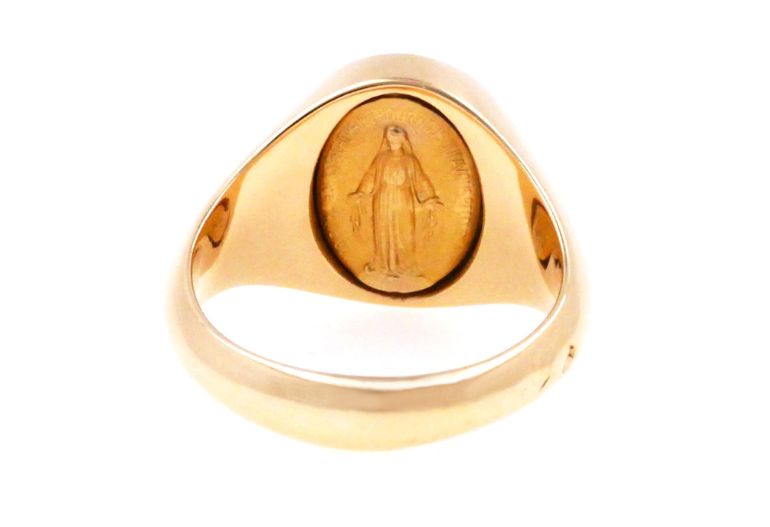
A miraculous medal was added beneath the family coat of arms.